TOFU. MOFU. BOFU.
Every marketer can recite this in their sleep. Awareness at the top, consideration in the middle, conversion at the bottom. Neat. Linear. Easy to put on a slide.
And completely useless in 2026.
The marketing funnel was built for a world where consumers moved in straight lines. See an ad, visit a website, maybe download a whitepaper, talk to sales, buy. One direction. One path. One predictable journey.
That world doesn’t exist anymore.
How People Actually Buy Today
Here’s what a real purchase journey looks like in 2026:
Someone sees your brand’s reel on Instagram while scrolling at 11 PM. They don’t follow you. They don’t click. They just… notice.
Two days later, a Meta ad shows up in their feed. They recognize the name. Still don’t click.
A week later, your founder posts something opinionated on LinkedIn. It shows up in their feed because a friend liked it. They read the whole thing.
Then they’re on YouTube and your brand has a 10-minute video breaking down something they actually care about. They watch 7 minutes of it.
Then an influencer they follow casually mentions your product in a story. Not a sponsored post, just a mention.
Then another reel. Then a friend talks about it. Then they Google your brand. Then they buy.
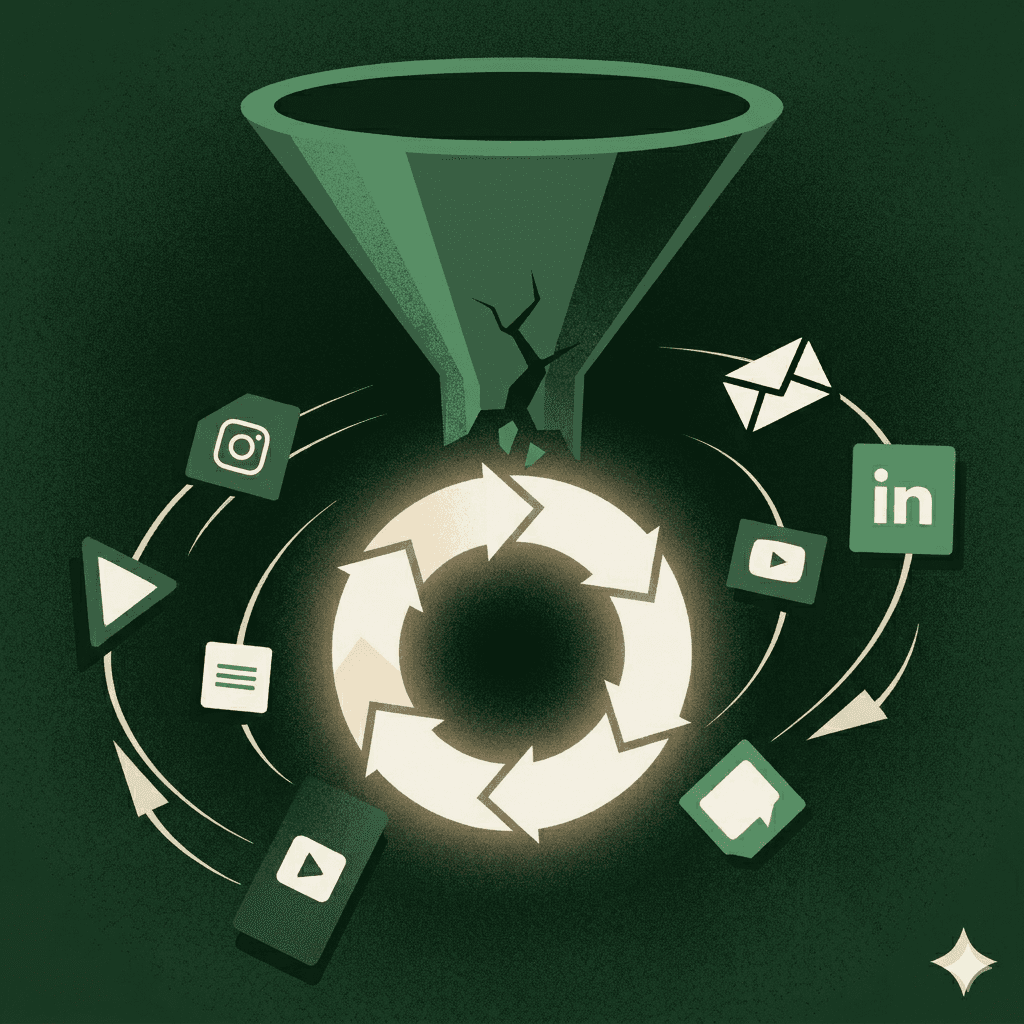
That’s not a funnel.
That’s a flywheel.
And the brands that figured this out are crushing everyone who’s still drawing triangles on whiteboards.
Why Ads and Influencers Alone Don’t Work Anymore
Most brands start their “flywheel” with two things: Meta ads and influencer collaborations. Then they wonder why nothing spins.
Here’s the problem.
Influencer Trust Is Crumbling
Less than 35% of consumers trust influencer recommendations (Clutch.co). And 53% of consumers trust a product less if they know the influencer was paid to talk about it (IZEA Trust Index 2025).
I’ll be honest: every time I see an influencer talk about a product now, my default emotion isn’t trust. It’s skepticism. I know the brand paid this person a lot of money to say nice things. And I’m not alone. That’s the majority of consumers now.
When crowdsourcing on social media, AI chatbots, and influencers were compared as information sources, influencers came dead last: only 17% of consumers preferred them, behind AI at 20% and crowdsourcing at 63%.
The deinfluencing movement didn’t come out of nowhere. It came out of an audience that got tired of being sold to by people pretending they weren’t selling.
Meta Ads Are Getting Expensive and Less Efficient
Meta reported a 14% jump in ad costs last year against only a 6% increase in impressions (GeistM). You’re paying more to reach fewer new people.
In March 2026 alone, advertisers saw CPM increases of 15% to 40% across categories (Digital Applied).
And here’s the stat that should keep performance marketers up at night: 11 out of 15 industries saw their marketing efficiency ratio decline year-over-year in 2025 (Triple Whale). That means those industries generated less revenue per dollar spent on Meta than the year before.
The playbook of “scale Meta ads and find cheaper influencers” isn’t just stale. It’s actively getting worse.
The Flywheel Needs an Engine. That Engine Is Organic Content.
Here’s what most brands miss about the flywheel.
Every touchpoint in that purchase journey I described (the reel, the founder’s post, the YouTube video), those aren’t ads. Those are organic content. Content the brand made because they had something to say. Not because they paid someone to say it.
Organic content is the piece that makes the ad feel familiar instead of intrusive.
Organic content is the piece that makes the influencer mention feel like confirmation instead of a pitch.
Without it at the center, the flywheel has no engine. You’re not running marketing. You’re just running ads in a circle.
The Data Backs This Up
Content marketing generates 3x the ROI of paid advertising: $3 returned for every $1 invested, compared to $1.80 for paid (Genesys Growth). It costs 62% less than traditional marketing while generating 3x more leads.
And here’s the kicker: businesses with strong organic foundations see 20-40% better ROI from their paid campaigns too (VantagePoint). Organic doesn’t replace paid. It makes paid work harder.
The brands winning on social in 2026 aren’t choosing between organic and paid. They’re building organically first, then amplifying what works. Proven organic content turned into ads consistently outperforms cold ad creative.
The Real Problem: Founders Won’t Let Their Teams Market
Brands spend tens of thousands a month on influencers without blinking. Six figures on Meta ads, approved without a meeting.
But a fraction of that on organic content? “Send me an ROI projection first.”
I’ve sat in 20 meetings with CMOs and marketing heads. Every single one knows organic content is what their brand needs. Every single one knows it builds long-term equity. Not one has pitched it to their founder.
Why?
Because if content doesn’t show ROI in 30 days, they’re the one who has to answer for it. So they play it safe. Influencer collabs. Performance ads. Same playbook. Stuff that shows up clean on a spreadsheet. Stuff the founder never questions.
Meanwhile, the brands that figured this out are pulling ahead.
Patagonia didn’t become a cultural brand through Meta ads. They built a movement around environmental storytelling: organic content that made people care about the brand before they ever bought a jacket.
Glossier didn’t outspend competitors on influencers. They built a community that created content for them. The flywheel spun because the audience was the engine.
These aren’t outliers. They’re the blueprint. And most brands are ignoring it because the playbook requires patience that founders don’t want to give their marketing teams.
Ads Are Rent. Content Is Equity.
Here’s the simplest way to think about it.
Every dollar you spend on Meta ads disappears the moment you stop spending. Pause the campaign, the traffic stops. The reach drops to zero. You own nothing.
Every piece of organic content you create stays. It compounds. A reel you posted 6 months ago still gets discovered. A YouTube video from last year still drives traffic. A founder’s LinkedIn post from 3 months ago still gets shared.
Ads are rent. You’re paying for temporary access to an audience you don’t own.
Content is equity. You’re building an asset that appreciates over time.
Most brands are paying rent every month and wondering why they never build wealth.
What the Flywheel Actually Looks Like
For brands ready to stop drawing funnels and start building flywheels, here’s what the system looks like:
Organic content sits at the center. The brand has a point of view. It creates reels, YouTube videos, founder posts: content that would be worth watching even if you never bought the product.
Paid amplifies what works. Instead of creating ads from scratch, you take organic content that’s already proven (the reel that got 100K views, the YouTube video with high retention) and put money behind it. This is why businesses with strong organic foundations see 20-40% better ROI from paid.
Influencers confirm, not introduce. When a consumer has already seen your organic content, an influencer mention feels like social validation. When an influencer is the first thing they see, it feels like an ad. The order matters.
The community feeds back into content. Comments, DMs, reviews, UGC: these become raw material for the next piece of content. The flywheel accelerates because the audience is generating fuel.
Each touchpoint makes the next one more effective. That’s the flywheel. That’s what the funnel was never designed to do.
The Bottom Line
The marketing funnel gave us a clean model for a messy world. It worked when media was limited, attention was abundant, and consumers had 3 channels to pay attention to.
In 2026, your consumer is on Instagram, YouTube, LinkedIn, WhatsApp, and Google, sometimes in the same hour. They don’t move through stages. They move through loops. They see you, forget you, see you again, research you, hear about you, and then decide.
The brands that win aren’t the ones spending the most on ads.
They’re the ones that show up so consistently across so many organic touchpoints that by the time the consumer sees the ad, it feels less like an interruption and more like a reminder.
That’s the flywheel.
And it starts with organic content. Not ads. Not influencers. Not a funnel.
Content.
Everything else just makes it spin faster.